Recurring transaction detection and confirmation
What does this feature do?
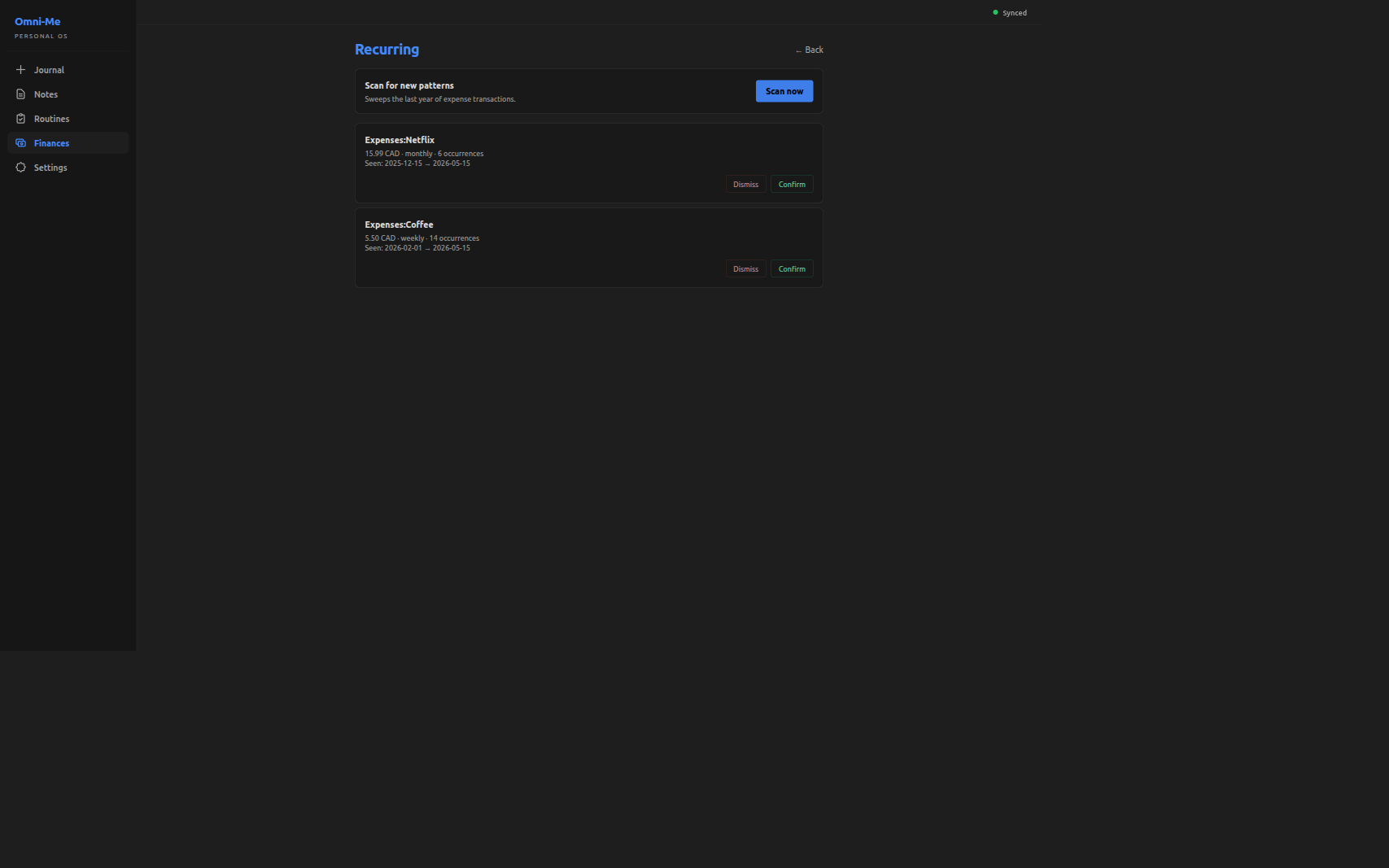
The Recurring screen, under the Finances tab, surfaces transactions that look like subscriptions or other recurring expenses — same category, same amount, consistent cadence — and lets the user Confirm or Dismiss each one. A "Scan now" button runs the detector immediately; a nightly background pass runs once the app has been up for a minute. Each pattern card shows the category, amount + commodity, cadence, occurrence count, and the first-to-last seen date range. Confirmations survive re-scans: the pattern id derives from the vendor/amount/cadence shape, so an already-tracked recurrence isn't asked about a second time.
Why was it added now?
Planning needs a list of recurring obligations: the dashboard's Recurring widget renders them, and the Can-I-Afford verdict subtracts next month's total from net worth before answering yes or no. Manually entering every subscription is the obvious way to populate that list — but the journal already carries the transactions, and a same-category / same-amount / consistent-cadence shape is detectable. False positives are the catch: a few coincidentally-aligned charges look like a pattern, so detection is a proposal that the user either Confirms or Dismisses.
What's in scope (and what's not)?
In: Scan-now + nightly background detection of expense recurrences; per-pattern Confirm/Dismiss; confirmed patterns survive re-scans.
Not in:
- Variable-amount patterns — a water bill that floats $40-$60 month-to-month won't match. Identical-amount is the constraint that keeps the false-positive rate sane.
- Income-side recurrences — the scanner sweeps expense legs only. Salary and stipend deposits would call for a different shape and different downstream value, so they belong in their own feature, not under Recurring.
How do we know it works?
cargo test -p omni-me-core --lib recurring::
running 11 tests
test recurring::tests::custom_cadence_returns_median_when_consistent ... ok
test recurring::tests::derive_pattern_id_is_stable ... ok
test recurring::tests::median_correctness_on_odd_length ... ok
test recurring::tests::stale_pattern_with_year_long_gap_is_rejected ... ok
test recurring::tests::monthly_with_28_31_day_variation_is_accepted ... ok
test recurring::tests::different_amounts_do_not_group ... ok
test recurring::tests::group_below_minimum_occurrences_is_skipped ... ok
test recurring::tests::irregular_gaps_are_not_recurring ... ok
test recurring::tests::monthly_pattern_detected ... ok
test recurring::tests::weekly_pattern_detected ... ok
test recurring::tests::weekly_with_one_outlier_is_still_recurring ... ok

test result: ok. 11 passed; 0 failed; 0 ignored; 0 measured; 358 filtered out; finished in 0.00s
Three buckets. Cadence classification (5 tests): real monthly cadences with 28-31-day jitter pass; a single off-rhythm gap in an otherwise weekly stream still counts as weekly; the median-day calculation lands correctly on odd-length gap sequences (a regression test for an off-by-one caught during the original implementation); custom cadences pass through with their median when gaps agree; truly irregular sequences are rejected. Scanner grouping and filtering (5 tests): monthly and weekly streams produce detected patterns; same-vendor transactions with different amounts don't merge; groups with fewer than three occurrences are skipped (MIN_OCCURRENCES = 3); a year-long staleness gap rejects an otherwise-clean rhythm. Determinism (1 test): the pattern id derived from the vendor/amount/cadence shape is stable across runs — what lets the user's Confirm or Dismiss survive a re-scan.
core/src/recurring.rs:57 at baf3fd4
pub fn classify_cadence(gaps_days: &[u32]) -> Option<u32> {classify_cadence — takes the sorted day-gaps between occurrences and returns the median cadence if every gap falls inside that median's tolerance bucket (7-day, 14-day, 30-day, or pass-through). The all-gaps-must-agree check is what keeps a few coincidentally-spaced charges from being labeled a pattern.
core/src/recurring.rs:97 at baf3fd4
pub fn detect_patterns(txn_rows: &[TxnPostingsRow]) -> Vec<DetectedPattern> {detect_patterns — the scanner entry. Groups transactions by (category, signed amount, commodity), drops groups below MIN_OCCURRENCES, sorts each group's dates, computes day-gaps, calls classify_cadence, and emits one DetectedPattern per accepted group.
tauri-app/src-tauri/src/recurring_scanner.rs:25 at baf3fd4
pub fn spawn(spawn — the boot-spawned nightly task. 60-second warm-up so the first scan doesn't compete with app startup, then a 24-hour cadence indefinitely. Each tick calls detect_patterns over the current journal and emits RecurringTransactionDetected events for pattern ids that aren't already in the recurring_patterns table.
The Recurring screen renders the Scan-now affordance at the top and one card per detected pattern below — each carrying the data the user needs to decide:
What's worth remembering or doing next?
- Inline-edit per detected pattern is deferred — the workflow today is binary Confirm/Dismiss. Workaround: dismiss + wait for the next scan, since the detector re-emits on its next tick. Revisit if dismiss-and-rescan starts to feel like real friction.
- Amount drift creates a new pattern, not an edit. The pattern id incorporates the amount, so a $15.99 Netflix bumping to $17.99 is a new pattern asking for a fresh Confirm.
- The cadence classifier's "median + per-bucket tolerance + all-gaps-must-agree" policy is a concepts-demo candidate — a playable page that takes a sequence of dates and shows when the classifier accepts vs rejects.