Financial-health dashboard
What does this feature do?
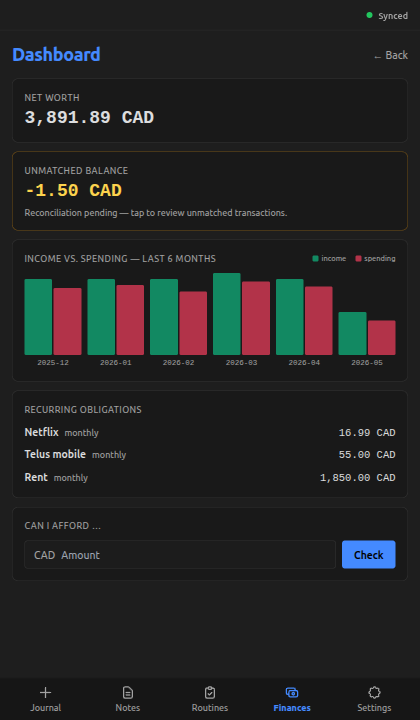
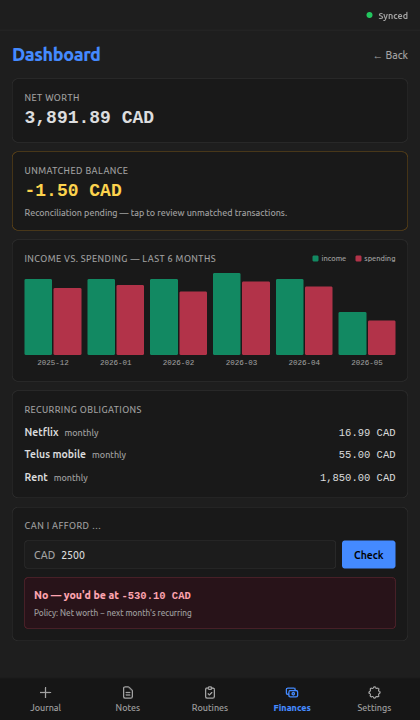
The Dashboard, under the Finances tab, is a single screen that answers a few "where do I stand right now?" questions at a glance. A net-worth card sums the user's tracked accounts in their base currency. An Unmatched balance card surfaces the reconciliation pending — a non-zero number means transactions are sitting in the clearing account waiting to be matched, and tapping it jumps into the transaction list filtered to those rows. A monthly trend bar chart shows income vs. spending over the last several months. A recurring obligations card lists the confirmed subscriptions and rent-shaped expenses from the user's confirmed recurring-pattern set. And a Can-I-Afford widget takes an amount and answers yes or no — its policy subtracts the next month's confirmed recurring obligations from net worth before deciding, so a tight-but-positive remaining isn't enough; the verdict goes "yes" only when there's room above the upcoming bills.
Why was it added now?
Personal finance "glance" is the answer to a few questions the user would otherwise answer by scrolling the transaction list and doing arithmetic: am I trending up or down this quarter?, are there obligations next month I'm not seeing?, is there room for this purchase right now? The Dashboard collapses each into a card so the answer is visible without further work. The moment was right because the data infrastructure had landed in pieces over the previous weeks: the per-account base-currency aggregation came up alongside the Accounts screen and made net worth a one-line sum; the auto-import pipeline started writing transactions into the clearing account so the Unmatched balance became a real signal; and the recurring-pattern table existed in the projection schema with a confirmed slot waiting for the detection scanner to populate it. The Dashboard's job was to turn that converged infrastructure into a glance.
What's in scope (and what's not)?
In: the five widgets, Unmatched click-through into the transaction list, Can-I-Afford with its recurring-aware verdict.
Not in:
- Custom trend windows — the monthly trend is fixed at the last few months; the Transactions screen carries date-range filtering for anything wider.
- Forecasting or projection — the dashboard answers "where do I stand now," not "where will I stand later."
- Per-widget configuration — no hide/show, reorder, or threshold alerts.
How do we know it works?
The aggregator and the policy each carry their own test surface:
cargo test -p omni-me-core --lib dashboard::
running 14 tests
test dashboard::tests::can_i_afford_false_when_balance_lands_exactly_zero ... ok
test dashboard::tests::can_i_afford_false_when_amount_exceeds_balance_minus_recurring ... ok
test dashboard::tests::can_i_afford_false_when_net_worth_unavailable ... ok
test dashboard::tests::can_i_afford_treats_negative_amount_as_refund ... ok
test dashboard::tests::can_i_afford_true_when_balance_clears_recurring_and_amount ... ok
test dashboard::tests::bucket_postings_drops_unconvertible_foreign_commodity ... ok
test dashboard::tests::bucket_postings_groups_by_month_and_flips_income_sign ... ok
test dashboard::tests::month_range_returns_continuous_oldest_to_newest ... ok
test dashboard::tests::distill_recurring_keeps_only_confirmed ... ok
test dashboard::tests::months_back_label_handles_year_rollover ... ok
test dashboard::tests::next_month_recurring_total_drops_foreign_commodity ... ok
test dashboard::tests::next_month_recurring_total_scales_by_cadence ... ok
test dashboard::tests::dashboard_summary_computes_net_worth_excluding_unmatched ... ok
test dashboard::tests::dashboard_summary_returns_no_unmatched_when_absent ... ok

test result: ok. 14 passed; 0 failed; 0 ignored; 0 measured; 303 filtered out; finished in 0.00s
Two buckets. Aggregator structure (9 tests): net worth excludes Unmatched, Unmatched optionality, trend bucketing including the sign-flip for Income:* postings, trend drops unconvertible foreign legs, recurring distillation keeps only confirmed rows, cadence-aware monthly total, month-range edges (year rollover and continuous oldest-to-newest). Can-I-Afford policy (5 tests): yes when net worth clears recurring + amount; no when the amount exceeds the headroom; no when balance lands exactly at zero (the strict-> rule from the policy decision); no when net worth is unavailable; negative amounts treated as refunds.
core/src/dashboard.rs:101 at baf3fd4
pub fn dashboard_summary(Pure-function entry point — produces the four-widget payload (net worth, Unmatched, monthly trend, recurring) from a parsed journal, declared accounts, and confirmed recurring patterns.
core/src/dashboard.rs:348 at baf3fd4
pub fn can_i_afford(amount: Decimal, summary: &DashboardSummary) -> AffordVerdict {The Can-I-Afford policy — strict-
>boundary so a balance landing exactly at zero reads as can't-afford.
Two shots from the rendered dashboard in mock mode. The overview first — all five widgets in their default state:
Then Can-I-Afford with a $2,500 amount typed in — the policy nets out the next month's $1,921.99 of recurring obligations before deciding, so the verdict comes back "No, you'd be at −$530.10":
What's worth remembering or doing next?
- The Can-I-Afford verdict treats net worth as a single number — it doesn't distinguish between liquid assets (cash you can spend today) and the credit-card liability offset that nets into the total. The next round of polish lifts the verdict into a liquidity-aware variant; revisit when "can I afford this without dipping into illiquid assets" becomes a real question.
- The Can-I-Afford policy-as-a-spectrum could be a concepts demo — naive cash check → cash minus next month's recurring → liquidity- aware → forecast-aware. Lets a reader play with the same inputs through each policy and see when the verdicts diverge; surfaces the load-bearing role of the policy decision itself.