Capture a transaction with its receipt
What does this feature do?
omni-me accepts a transaction through four entry points: a photo, a PDF, the body of an email, or a typed form. The first three route through the server's document extractor, which produces a draft transaction the user confirms. The captured file itself is stored content-addressably on the server and mirrored to an on-device cache, so the original document stays viewable from the transaction record.
Why was it added now?
The budget pipeline existed end-to-end on the backend before any of this work began: 16 event types, 12 Tauri commands, and three auto-import sources running server-side. None of it had a UI inbound path. The commands were orphan code, reachable only from DevTools — usable on paper, unreachable from the app.
Automatic import — Globepay, Northwind, and an email IMAP poller — was the foreground work for the preceding stretch; the previous personal-finance tracking attempt collapsed when manual sync became tedious enough to abandon, which is why automation got priority. But automatic import only covers what the user's banks export. Everything else — paper receipts, photo receipts, ad-hoc cash transactions, statements from accounts without an API — still needs a hand-driven entry path. Capture is that path.
Persisting the captured file alongside the transaction was the last sub-step before capture meant what it sounded like. Without it, the receipt is discarded the moment the transaction is saved, and the auto-import-vs-manual distinction collapses into "either way the source document disappears."
What's in scope (and what's not)?
In:
- Four entry points (photo, PDF, email body paste, manual typed form) all routing to a single confirm-and-save form
- Server-side document extraction (Gemini multimodal; one extractor across all four entry points)
- Content-addressable blob storage for the captured file, mirrored to an on-device LRU cache (200MB cap)
AttachmentRefride-along on the recorded transaction event
Not in:
- Browsing the saved transactions. Save commits the event, but no list view exists yet — captured transactions "vanish" until that ships.
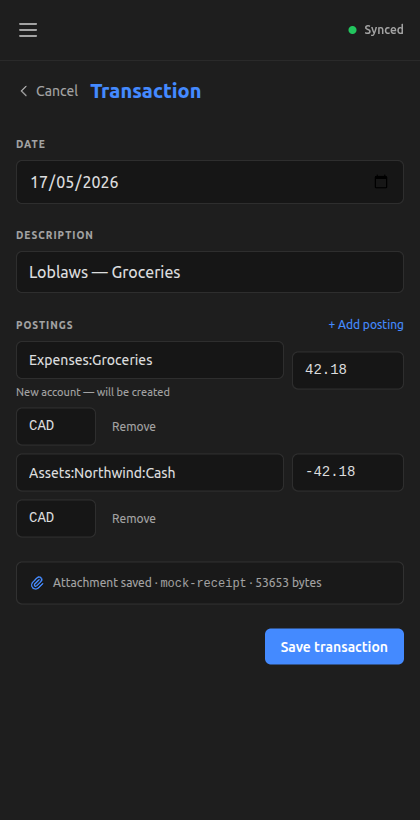
- Thumbnail rendering in the confirm form. The form shows "Attachment saved · filename · N bytes," not the image; rendering ships with the transaction detail view.
- Android share-sheet integration. Sharing an image or PDF to omni-me from another app's share menu doesn't work yet — the manifest declaration and Rust glue are both partial. Deferred to a focused Android-build session.
How do we know it works?
The on-device attachment cache passes its unit tests — write-then-read roundtrip, miss-returns-None, eviction by mtime order, invalid-hash rejection, and the clear-removes-files-keeps-dir contract that the upcoming Settings cache panel will rely on:
cargo test -p omni-me-app commands::attachments Compiling omni-me-app v0.1.0 (/home/me/productive_learning/projects/omni-me/tauri-app/src-tauri)
Finished `test` profile [unoptimized + debuginfo] target(s) in 1m 28s
Running unittests src/lib.rs (target/debug/deps/omni_me_app-27d056b92e887d61)
running 5 tests
test commands::attachments::tests::invalid_hash_rejected ... ok
test commands::attachments::tests::miss_returns_none ... ok
test commands::attachments::tests::write_then_read_roundtrips ... ok
test commands::attachments::tests::clear_removes_files_keeps_dir ... ok
test commands::attachments::tests::evict_drops_oldest_first ... ok
test result: ok. 5 passed; 0 failed; 0 ignored; 0 measured; 29 filtered out; finished in 0.10s
Running unittests src/main.rs (target/debug/deps/omni_me_app-06b87a890aefce3c)
running 0 tests
test result: ok. 0 passed; 0 failed; 0 ignored; 0 measured; 0 filtered out; finished in 0.00stauri-app/src-tauri/src/commands/attachments.rs:1 at baf3fd4
//! Local attachment cache (Phase 3.7).The cache module — the five tests at the bottom
#[cfg(test)] mod testsblock exercise the LRU in isolation, no Tauri runtime involved.
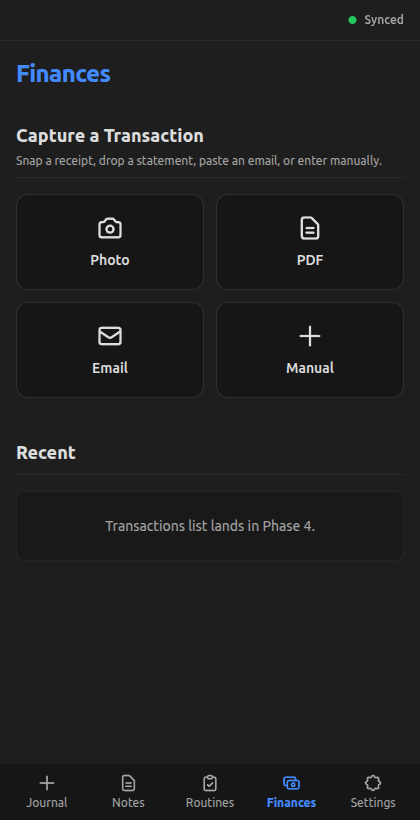
The end-to-end capture-then-confirm flow walks through under dx serve --features mock. The Finances tab opens to a capture-tile grid:
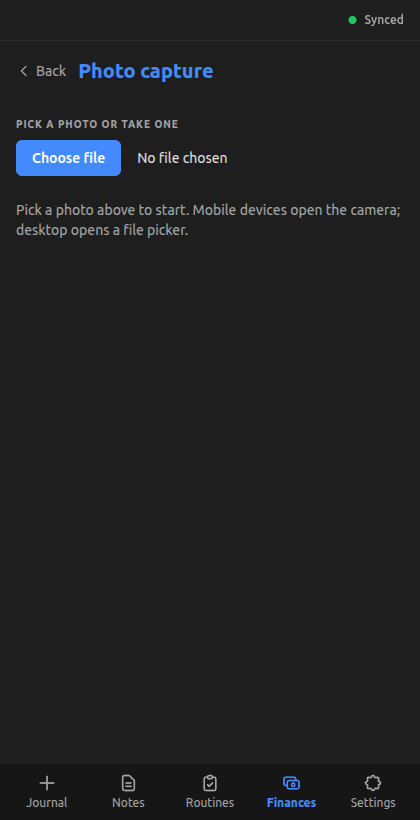
Tapping Photo opens the file picker — mobile devices default to the rear camera; desktop opens a chooser:
Picking a file kicks off the extract round trip. The confirm form lands pre-populated — date, description, two postings — with the "Attachment saved · filename · N bytes" line acknowledging that the captured bytes were persisted server-side and mirrored to the on-device cache:
server/src/routes/documents.rs:46 at baf3fd4
async fn extract_handler(The
extract_handler— when?attach=trueis set on the query, the same body bytes that get extracted are hashed and stored into the blob dir; the response carries theAttachmentRefback in one round trip.
What's not in the evidence yet: the live Gemini round trip is unobserved. The mock backend returns a canned receipt regardless of input bytes; the real extract_document path compiles and the server boots, but no live document has been pushed through end-to-end. This is acknowledged here so the post stays honest; if a live-extraction verification happens later, this section gets updated.