Account list with multi-currency balance aggregation
What does this feature do?
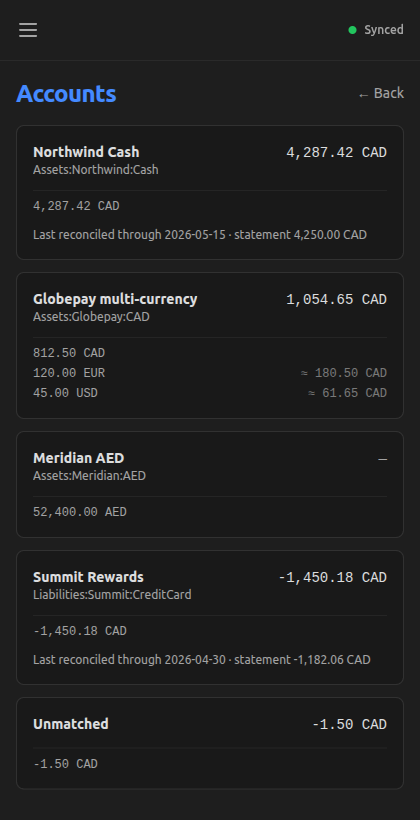
The Accounts screen, inside the Finances tab, lists the balances of the user's tracked accounts at a glance. Each row shows the account name, its per-commodity holdings (e.g. 42.18 CAD, 100.00 USD), and a single aggregated total converted into the user's base currency using the latest available exchange rate. When an account was last reconciled against a statement, the row also surfaces the reconciliation date and the statement-balance figure. The screen uses an explicit allowlist of accounts to surface — including the top-level Unmatched clearing account — so newly-discovered sub-accounts from auto-import don't pollute the view until they earn a place. Commodity rows without an available rate stay visible in their native amount but drop out of the base-currency total, which renders as — when nothing converts.
Why was it added now?
The user holds money in several currencies, at multiple banks. A typical mix today spans CAD, USD, EUR, and AED, and that set tends to grow as new activities come up. Without a surface that converts those holdings into one figure, "how much do I have right now" requires re-doing the FX math across banking apps or a spreadsheet. The Accounts screen collapses that lookup into a glance. The moment was right because the rate sources the journal needed had landed alongside the recent auto-import push: a daily-rate fetcher writing price directives for the major currencies, plus the auto-import review flow capturing manual rates for the long-tail currencies at the moment a statement arrives. Both wrote the same hledger P-directive shape, so a single aggregator could fold them in without further infrastructure. The financial-health dashboard queued up next would need the same aggregator for net worth, so shipping the Accounts screen first kept the surface narrow enough to prove the converging-rate path on a useful screen in its own right.
What's in scope (and what's not)?
In: balance listing, per-commodity rows with base-currency aggregation, latest reconciliation date and statement balance.
Not in:
- Per-account drill-down — the Transactions screen handles that via its account-filter chip.
- Historical balance trends — the dashboard owns trend.
- Editing reconciliation status — the screen surfaces what previous statement imports already wrote.
How do we know it works?
The pure aggregation function carries 8 tests covering the categories the screen promises:
cargo test -p omni-me-core --lib balances::
running 8 tests
test balances::tests::account_summaries_handles_empty_journal ... ok
test balances::tests::is_listable_account_includes_user_allowlist_only ... ok
test balances::tests::account_summaries_aggregates_cad_passthrough ... ok
test balances::tests::account_summaries_keeps_unmatched_clearing_account ... ok
test balances::tests::account_summaries_includes_declared_account_with_zero_balance ... ok
test balances::tests::account_summaries_splices_declared_metadata ... ok
test balances::tests::account_summaries_marks_unconvertible_commodity_with_none ... ok
test balances::tests::account_summaries_converts_foreign_commodity_via_p_directive ... ok

test result: ok. 8 passed; 0 failed; 0 ignored; 0 measured; 309 filtered out; finished in 0.00s
Three buckets. Convertibility math — base-currency passthrough, P-directive conversion, the unconvertible-commodity fallback that keeps a row visible in native units when no rate is available. Account surfacing — the allowlist drop-by-default, declared accounts surfaced even when balance is zero, the Unmatched clearing account preserved alongside the rest. Declared-account metadata splicing — joining the reconciliation date and statement balance onto the computed balance so the screen can show "last reconciled through X · statement Y."
core/src/balances.rs:83 at baf3fd4
pub fn account_summaries(Pure-function entry point — takes journal content + declared accounts + base currency, returns one summary per surfaced account with per-commodity rows and a base-currency total.
core/src/balances.rs:257 at baf3fd4
mod tests {Test module — fixtures + the 8 test cases that exercise the three buckets above.
The rendered screen shows the multi-commodity row in context — the Globepay account folds CAD, EUR, and USD into a single CAD total, and the Meridian AED account shows the — badge where no rate is available to convert the native amount:
What's worth remembering or doing next?
- The surfaced-accounts list lives in
LISTABLE_ACCOUNTSas a hard-coded slice for now; lifting it into a Settings-managed table is queued for the next round of polish. Revisit when a newly-discovered account becomes a surface the user wants to glance at regularly. - How
Pdirectives compose into aPriceslookup could be a concepts demo — visualizing what a single price entry contributes vs. the accumulated table, why "latest rate ≤ date" wins, and whatinsert_fromactually does when a journal carries multiple rates for the same currency pair.